
A single-elimination tournament eliminates each team after one loss, winners advance until one champion remains. They are common formats for most sports tournaments especially when there is limited playing fields or time..
Structure
Rounds: organized as rounds (Round of 16, Quarterfinals, Semifinals, Final).
Bracket tree: visualizes matchups. Each match’s winner advances to the next node.
Number of Teams: Works best with a multiple of two (2, 4, 8, 16, 32…). If not, assign byes to the top teams in the season so the second round is even.
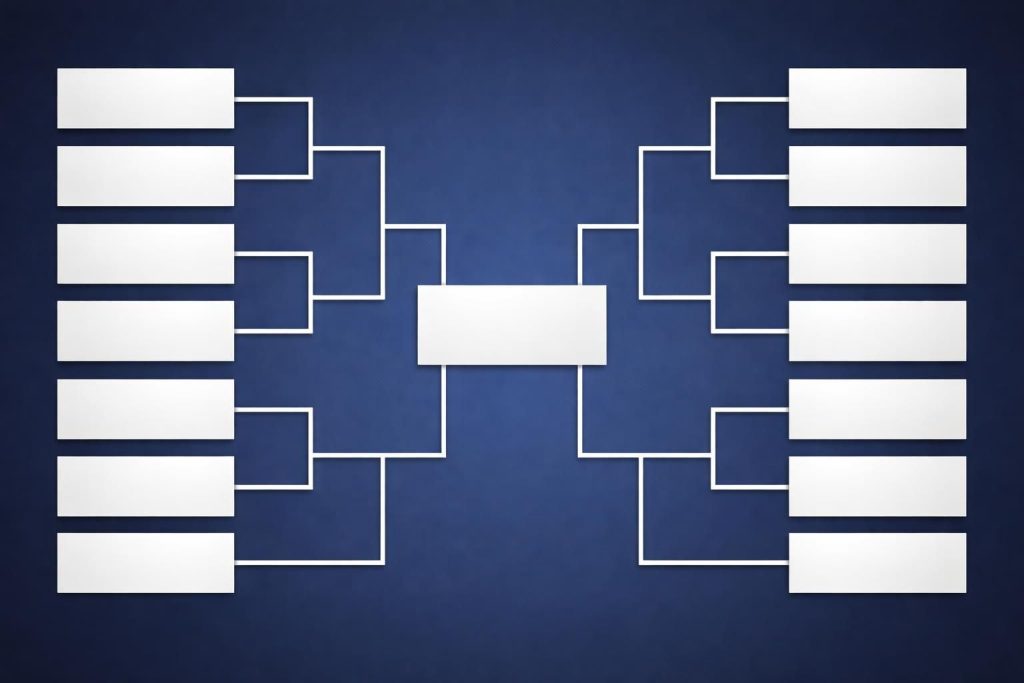
Seeding and placement
Seeding ranks participants to spread out top competitors so they meet later and reward performance during the season.
Standard seeding pairs: 1 vs last, 2 vs second-last, etc. (e.g., in 8-player: 1v8, 4v5, 3v6, 2v7).
Alternatives: random draw, protected seeds or regional brackets.
Handling non-multiple-of-two fields
Assign byes to highest seeds so they skip the first round.
Example: 10 teams → next power 16 → 6 byes; seeds 1–6 receive byes, seeds 7–10 play preliminary matches to reach 8.
Scheduling matches
Order rounds so winners have rest time as needed.
Use parallel matches within a round to shorten tournament length.
For bracket fairness, keep consistent match conditions (field, time limits).
Tiebreakers and match rules
Define match length, overtime, tie procedures and substitution/forfeit rules before starting.
For multi-game series, bracket nodes can represent best-of-N instead of single games.
Common variants and considerations
Consolation brackets: give eliminated players more games and determine lower-place rankings.
Double-elimination: allows one loss before elimination.
Third-place match: play a match between semifinal losers if you need a bronze place.
Reseeding vs fixed bracket: reseed each round by remaining seed ranks (keeps highest vs lowest) or keep fixed bracket paths (predictability).
Creating and using a bracket
List entrants and assign seeds (ranked or random).
Determine bracket size and calculate byes if needed.
Place seeds into bracket positions (standard seeding pattern).
Publish bracket and schedule (dates, times, locations).
Play round 1 matches; record winners and update bracket.
Continue through rounds until final; declare champion.
If required, hold consolation/third-place matches.
Practical tips
Use bracket-management software or printable templates for accuracy.
Communicate rules, schedule, and tie procedures to all participants beforehand.
Mark match results promptly and keep a public-updated bracket to avoid confusion.
For fairness, avoid giving excessive rest advantage to some players beyond byes.
You can also always pare down a larger bracket template to match your needs.
Leave a Reply