
You signed up to help kids play sports. You didn’t sign up to be hooked up with all those emails, schedules and roster issues at 11 p.m. on Tuesday. Yet here you are. You are a league commissioner, board member, or league secretary, and you are well aware of the responsibility placed on your shoulders each season. Follow-ups, changing the setting and parent complaints add up quickly. Youth league volunteers are a major force behind community sports, and burnout is slowly driving good people away.
Youth leagues suffer from administrative burnout as a result of non-systematic manual and repetitive tasks. Volunteers can contribute to the reduction of this by ensuring there is a consistent process, clear roles, scheduling tools, communication automation, and boundaries on the time volunteers can spend.
Why Volunteer Burnout Is a Real Problem Right Now
Participation in youth sports has bounced back strongly in recent years, but so have the number of volunteers. Leagues are playing more divisions, more age groups and more games than ever, all in the hands of a few dedicated individuals. The result? Commissioners are pulling double duty. Secretaries are taking calls over the weekend. Board members are burning out in the middle of the season.
Common pressure points include:
Manual scheduling where each time a field becomes unavailable, it occurs
No single method of communication, such as group chat, emails, and phone trees, is running at the same time
No role clarity results in the same three people doing everything.
No guarantee that your registration won’t fail just because the season starts
Registration problems all the time when opening a new season
No time off between the seasons, planning for this season begins as soon as the previous season finishes.
What Eats Volunteer Hours: A Realistic Breakdown
| Task | Manual Time Per Week | With Clear Systems |
| Scheduling & rescheduling | 4–6 hours | 1–2 hours |
| Parent/player communication | 3–5 hours | Under 1 hour |
| Registration management | 3–4 hours (peak) | 30–60 minutes |
| Conflict resolution & follow-up | 2–3 hours | 1 hour |
| Reporting & record-keeping | 2 hours | Under 30 minutes |
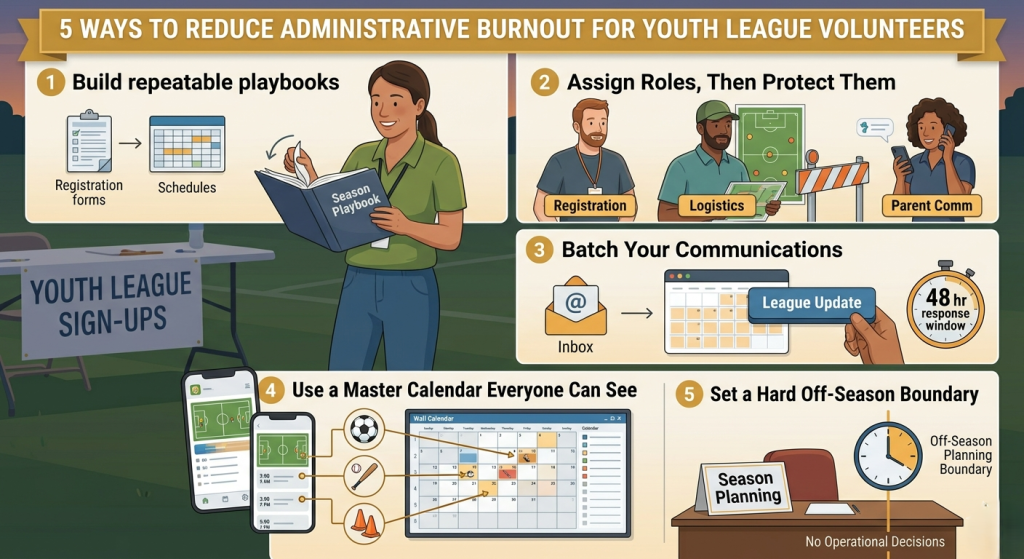
5 Ways to Cut Administrative Burnout for Youth League Volunteers
1. Build repeatable playbooks for every activity
Do not “reinvent the wheel” every season. Document
registration
development schedules
resolution of registration conflicts
A one-page process is better than a tribal knowledge system every day of the year.
2. Assign Roles, Then Protect Them
If one person is wearing multiple hats, then it’s a matter of time before burnout kicks in. Establish clearly who’s in charge of registration, field logistics, and parent communication. One person should not do all these tasks alone. These are three distinct roles and require a qualified person to handle them. Overlapping responsibility creates duplicated work and missed handoffs.
3. Batch Your Communications
Send league-wide updates, rather than responding to each and every question. Establish a timeframe (48 hours) for questions to be answered, not right away. With these methods, you get more hours within your week to handle other key tasks.
4. Use a Master Calendar Everyone Can See
Use a calendar that every employee in the league can access to eliminate the I didn’t know calls. One unified calendar eliminates much of the scheduling confusion.
5. Set a Hard Off-Season Boundary
Establish a clear window for making decisions about operations. Use this time for planning for the coming season.
Let Technology Do the Heavy Lifting
Systems beat willpower every time. Leagues that survive for long have eliminated manual tasks. You can structure registration, scheduling, and communication workflows to be automated. This reduces manual tasks that can take up much of your staff’s time. And this is why we built League Time. We give you practical tools, playbooks, and support structure to reduce the administrative load so volunteers can focus on what they showed up for, the game.
Ready to build a league that doesn’t burn your volunteers out? Visit leaguetime.com to explore resources built for organizers like you.
Leave a Reply